


A Day in the Life of a Dakota Homesteader (Early 1900s)

Spring Planting on the Dakota Prairie, Early 1900s
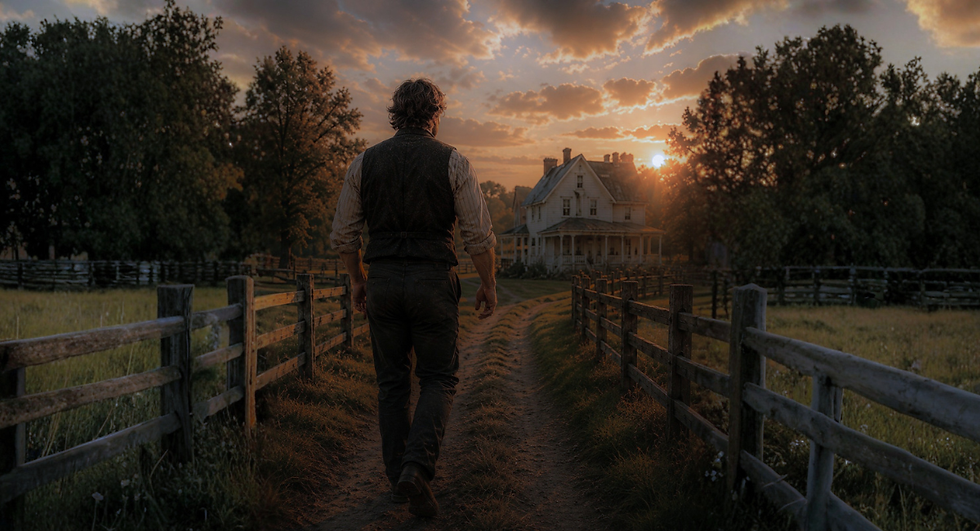
Before the homesteads became legends. Before the old photographs faded. Before the names carved into fence posts were swallowed by grass and time, there was a Monday in May that looked something like this.
Not a romantic Monday. Not a Monday from a painting. A Monday with mud caked to the knee, with a back that ached before the sun was fully up, with horses that needed tending before a man had swallowed his first cup of coffee. A Monday that held no guarantee the frost was truly done, because this was the Dakotas, and the Dakotas made no promises.

This is that Monday.
4:30 A.M. — The Dark Before the Work
He was awake before he was conscious of being awake. It happened this way every morning in planting season, a slow surfacing from sleep. It was pulled up not by an alarm but by the weight of everything waiting to be done. The soddie, or the modest frame house if the farm was a few years old, had grown cold overnight. The coals in the iron stove were a dull, dying red. The first order of business, before boots, before breakfast, before any thought about the fields, was to get the fire going.
Outside, the prairie in early May was a different animal than the prairie of winter. The cold was no longer trying to kill you outright. It was merely indifferent, a biting, 35-degree indifference that fogged the breath and stiffened the fingers and made the short walk to the barn feel longer than it was. The sky was still the deep, blue-black of a night reluctant to let go, and the stars were fading one at a time at the western edge.
The dogs always knew. Before his boots hit the porch, they were up and at the door, tails moving with a quiet, steady rhythm. They wanted to work. Everything on a Dakota homestead in the early 1900s wanted to work. That was the bargain.
5:00 A.M. — The Barn Comes First
The barn was the center of everything, and he entered it the way a man enters a church, purposefully, with the understanding that what happened here mattered. The horses heard him on the frozen ground before he reached the door. The big Percheron-crosses shifted in their stalls, the heavy sound of their hooves on the plank floor a language he had learned to read over years. Contentment. Hunger. Impatience.
He hung the lantern on the iron hook and moved down the aisle, talking to them the way his father had talked to the horses back in Norway, a low, steady narration that meant nothing in particular and everything in general. He pitched hay into the mangers first, because a horse that ate was a horse that worked, and today was going to demand everything they had.
The harness was stiff from the night's cold, and he worked neatsfoot oil into the leather by feel, checking every buckle and every strap with a methodical patience that could not be rushed. A snapped trace at noon on the far end of a half-plowed field was a disaster that cost him two hours of daylight. He had learned that lesson once. He did not intend to learn it twice.
Then came the cows, the chickens, the water hauled from the well. Each task had its own particular sound and smell, the deep, bovine patience of the milk cows, the sharp, dusty complaint of the hens, the clean, mineral scent of the well water as it hit the wooden buckets. By the time the first pale grey light appeared at the eastern edge of the prairie, he had already been working for an hour.
He went inside for breakfast smelling of horse sweat and hay, and he was not apologetic about it. That smell was the smell of a farm that was alive.
6:30 A.M. — Breakfast at the Table
The kitchen was the warmest room in the house, and in planting season, it operated like a small factory from before dawn until after dark. His wife had the cast iron skillet going before he was back from the barn. Salt pork, fried until the fat ran golden. Potatoes from the root cellar, sliced thin and crisped in the drippings. Eggs from the hens. Dark rye bread sliced thick, with fresh butter, because they had a cow and a churn and the bread was something a person could hold on to.
Coffee, black and boiled, in a tin cup that was too hot to hold and too necessary to put down. He drank it standing at the table, going over the day in his head. The south field first, it had dried the fastest after the spring melt. The north quarter was still heavy, still holding the melt in the low spots, the kind of gumbo mud that could swallow a wheel up to the axle and ruin a morning. He would leave it for Wednesday if the wind held.
His children ate quietly, understanding the particular tension of the planting season without being told. Even the young ones knew that May was not a month for dawdling at breakfast. The older boy had his own list of chores that would begin the moment he swallowed his last bite, fence line to check, wood to split, water to haul. There was always more water to haul.
The meal was done in fifteen minutes. He pulled on his coat, pushed his hat down over his ears against the morning wind, and went back outside. The sun was clearing the horizon now, burning away the blue-grey of the early morning and turning the prairie to gold. It was a beautiful thing to look at, and he allowed himself exactly one moment to look at it. Then he went to hitch the team.
7:30 A.M. — Into the Field
The breaking plow went into the earth with a sound like a long, slow zipper being pulled through the skin of the world. He felt it through the handles, through his arms, into his shoulders, the resistance of ten thousand years of matted prairie grass and compacted soil fighting the steel blade. The horses leaned into their collars, their massive haunches working in a rhythm that was almost musical, and he walked behind them for hours, holding the line steady, watching the dark ribbon of turned earth appear to his left.

This was plowing, and plowing was not romantic. It was a conversation between a man, two horses, and a piece of ground that did not particularly want to be farmed. The prairie grass roots were deep and stubborn, and they grabbed at the share with a persistence that required constant pressure to overcome. Every few furrows, he stopped to hone the plow share with his whetstone, the rhythmic scraping sound carrying across the open field, because a dull blade was the enemy of progress and he could not afford to lose ground.
The sky above the Dakota prairie in May was enormous. It was a pale, enormous blue that seemed to press down on the flat horizon from every direction. A hawk circled to the south. In the distance, toward the coulee, a line of bare cottonwoods stood like weathered fence posts, their new leaves still too small to make any noise in the wind. He was aware of all of it in a peripheral way, the way a man is aware of his own heartbeat, constantly, without having to think about it.
By mid-morning his back was talking to him in a dull, rhythmic language that he had learned to ignore until noon. He stopped once to water the horses at the trough he had dragged to the edge of the field, watching them drink with the greedy, efficient thirst of animals that had been working hard. He poured water on his own face from the clay jug tied to the side of the plow, and he ate a cold piece of salt pork and a wedge of rye bread that had gone a little stale from sitting in his coat pocket since breakfast.
It was not a bad life. Hard, yes. Relentlessly, physically demanding in a way that modern language struggles to describe. But there was something in the long, quiet furrows, in the smell of the turned earth and the sound of the wind moving over the new-broken ground. It made a man feel he was doing exactly what he was supposed to be doing. The prairie did not offer comfort. It offered purpose, and for a Norwegian immigrant who had crossed an ocean to stand in this flat, windswept place and call it home, purpose was enough.
Noon — The Brief Pause
His wife, or perhaps the oldest child, would bring dinner to the field. Not lunch, the Scandinavian immigrants of the Dakotas called it dinner, and it was a meal that deserved the name. A bucket of potato soup, thick and steaming inside a cloth wrapping. More bread. Dried meat. On a good day, a jar of the sweet-sour pickled herring that reminded everyone at the table of Norway, even the children who had been born here and had never seen a Norwegian fjord.
They ate sitting on the overturned plow or on the tongue of the wagon, the horses standing hipshot nearby, resting their weight with a patience that was almost bovine. He looked at the field behind him, how much had been turned, how much remained. He looked at the sky, reading it the way prairie farmers always read the sky: not with alarm, but with attention. The clouds to the northwest had the wrong color. Not wrong enough to stop work, but wrong enough to note.
Thirty minutes. That was all he allowed himself. The horses needed the break more than he did, and he gave it to them without resentment, because a tired horse at two o'clock was a dangerous horse at four. Then he stood, brushed the crumbs from his trousers, and picked up the lines again.
Afternoon — When the Real Work Began
If the morning was about breaking ground, the afternoon on a planting day was about preparation and faith. Where the field had already been turned in earlier days, the disc harrow went in now, a brutal, rattling machine pulled by the same patient team that had pulled the plow, its sharp circular blades chopping and pulverizing the heavy clumps of sod into something approaching a seedbed. The work was deafening compared to the relative quiet of plowing, and it sent the smell of dark earth rising up in waves that a man could almost taste.
On a day when the ground was ready, the grain drill came next. He had inspected the seed the night before, running his hands through the sacks of flax or wheat with the focused attention of a man who understands that what goes into the ground today is everything that comes out of it in August. Bad seed was a year lost. On the Dakota prairie in the early 1900s, a year lost was not a setback. It was a catastrophe. The flax, when conditions were right, was the cash crop, the great blue gamble of the northern plains. It grew fast in the raw, newly broken earth, its shallow roots threading through the virgin sod like a promise.

By mid-afternoon, the muscles across his shoulders had gone from aching to a deep, burning numbness that he had learned to work through rather than stop for. The wind had picked up from the northwest, confirming what he had noted at noon, but it had not turned into the thing he feared. It was just wind. The Dakotas were always just wind, right up until they weren't.
Evening — The Animals Come First, Again
He quit the field when the light told him to, not a minute before. The horses knew before he did. Their heads came up, their pace changed, and he could feel through the lines the particular shift in energy that meant they understood the barn was close and the work was almost done. He guided them in, unhitched them with the same careful attention he had given them in the morning, and spent twenty minutes rubbing them down with rough burlap. They had earned it.
The evening chores were the mirror image of the morning ones, with exhaustion added. The cows were milked. The chickens were shut in. The water was hauled. The fire in the house was built up against the coming night, which in May could still drop to near freezing by midnight and threaten the seedlings he had been coaxing in the kitchen window since March. He checked those seedlings every evening with a tenderness he rarely showed anything else. They were small, fragile green things in tin cans and cracked clay pots, waiting for the last frost date to pass so they could be set into the ground.
He ate supper at the wooden table his own hands had built, in the house his own hands had built, on land that he had broken from raw prairie with nothing but his own physical determination and the willingness to stay. The meal was simple, whatever his wife had managed to put together from the root cellar and the smokehouse and the garden that was just beginning to show green. He ate everything on his plate. He was not capable of doing otherwise.
After Dark — The Thinking Hours
There was a window between supper and sleep that belonged to something other than labor. Not much of a window, an hour, maybe two, before the exhaustion of a planting day pulled a man under completely. But he used it. He sharpened the plow share for tomorrow, the whetstone moving in long, rhythmic strokes in the light of the kerosene lamp. He looked at the land book, the simple ledger where he tracked what had been planted and where, how many bushels of seed had gone in, what it had cost and what it might yield.
His wife, if she was not already asleep in the chair, sat nearby with her knitting or her mending or her endless, sacred work on the quilts for the Ladies Aid at the church. They talked, or they did not talk. There was a language in the silence of a Dakota homestead at night. It was a language of shared exhaustion and shared purpose and the particular comfort of being in the same room as the person who understood exactly how hard the day had been.
Sometimes, if the children were asleep and the lamp was burning low, he would step back outside for a moment. Not for any reason. Just to stand in the yard in the dark and look at the sky. The prairie sky at night in May was staggering, a vast, cold brilliance of stars from horizon to horizon, unobstructed by any ridge or tree line, laid out above the dark, sleeping land like a map of everywhere he had ever been and everywhere he would never go.
He did not stay long. Tomorrow started at 4:30, and the horses were already resting, and the seed was in the ground, and the land was as ready as it was going to be. He went inside, pulled off his boots, and was asleep before his head had fully settled into the pillow.
What Was Left Behind
The early 1900s homesteader on the Dakota prairie did not leave memoirs. He left furrows. He left fence lines. He left the dark, turned earth of a field that a century later would still remember the shape of the land he broke. He left children who grew up knowing what it meant to work before the sun was up and to keep working after the sun went down, who carried that knowledge in their bodies the way the prairie carries water, quietly, deeply, in places you can't see until you dig.
He left the bones of houses and barns that leaned into the prairie wind for eighty years before they surrendered. He left the faint indentation of a well that fed a family for three generations. He left the barely visible rise of a sod wall that was, for a while, the only thing standing between a family and the full ferocity of a January blizzard.
He left seeds in the ground. That was always the act of faith at the center of all of it, the willingness to put something into the earth and trust that the earth would give it back.
That is worth remembering. That is, in fact, why we remember.
— — —
Read more in The Sunstone Path, the story of Albert and Regina, and the land that made them. Coming 2026. Join my newsletter to follow along.


Comments