


Cape Disappointment Is Anything But

If you think a brutal sea and a barren landscape are the only hazards at Cape Disappointment, you’ve never had to make a midnight run to the Long Beach emergency room with a child burning up from a terrifyingly high fever. That chaotic night, complete with an eight-hour wait, a whopping $3,000 out-of-network bill, and an aging ER doctor who literally rolled into the room using a walker, is just one of the reasons this rugged park became the backdrop for several family survival stories in The Unbreakable Anchor. In fact, the landscape left such a permanent mark on our history that an original photograph of the driftwood and shifting tides at Cape D eventually became the actual cover of the book.
Tucked into the extreme southwest corner of Washington State, right where the mouth of the Columbia River collides with the crashing waves of the Pacific Ocean, lies a place that completely contradicts its own name.

For years, my definition of Cape Disappointment was painted in a very specific shade of Pacific Northwest green. It was the color of my dad's old Toyota truck, that bright green rig topped with a red-and-white canopy that served as the carriage for our family's childhood adventures. Back when the park was still called Fort Canby, we only pulled that truck in there once, a short stop in the middle of a longer vacation down the Oregon Coast. It was a brief detour, but it became permanently burned into my memory for one reason: the wind. It was the kind of wind that whipped you right in the face, relentless and raw, sand peppering your skin until you ducked for cover. My mom hated it there. The wind never stopped. After that trip, my parents never returned, at least not until years later, when we convinced them to experience it again through the eyes of their grandchildren.

That first visit wasn't much to write home about. The driftwood graveyard. The piles of sand going on forever. The absence of trees in every direction. What I remember most is a landscape stripped bare, open and indifferent to the people standing in it. My dad had brought us to explore the old fort, which stood tall over the ocean and didn't disappoint, but the rest of the place had a raw, almost hostile quality that we weren't prepared for. It's ironic that what was little more than a windy pit stop in my youth would eventually become one of the most meaningful places in our family's story and a recurring backdrop in The Unbreakable Anchor.

The name itself has a story worth telling. In 1788, English captain John Meares was searching for what he'd heard called the Great River of the West. When he reached this stretch of coastline, the treacherous sandbars concealed the river mouth so completely that he mistook it for nothing more than a shallow bay. Convinced there was no river to be found, he sailed on. He named the headland accordingly. Four years later, Captain Robert Gray found what Meares had missed. He navigated through those shifting sandbars and into the mouth of the river, naming it the Columbia after his ship. Gray's Harbor County here in Washington was named in his honor. What Meares saw as an ending was really just a hidden beginning, a river so vast and powerful it concealed itself behind its own geography.
Lewis and Clark made their way here too, completing their extraordinary journey from Missouri all the way to the edge of the continent. You can stand in the interpretive center today and read their words, carved into a tree at the top of the bluff after they climbed up to take in the view: "By Land from the U. States in 1804 & 1805." Nearby, Fort Canby still stands, originally built during the Civil War and later expanded into an important coastal defense battery during World War II. For my boys, those visits were more than a history lesson. They were a reminder that the people who came before us faced impossible odds and kept going anyway.

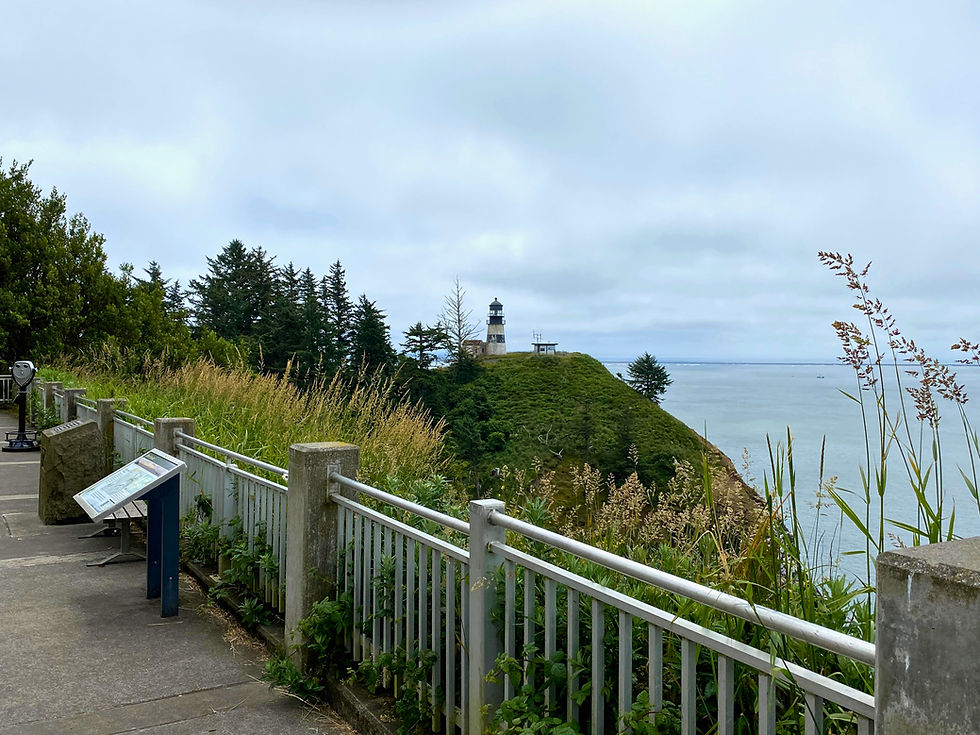
If you stand at the edge of the cliffs today, it becomes immediately clear why this stretch of coastline earned its grim reputation as the Graveyard of the Pacific. The headland is so rugged and deceptive, the sandbars so treacherous where the mighty Columbia River meets the open Pacific, that a single lighthouse wasn't enough to protect the ships trying to navigate it. It required two. Perched high on the cliffs is the Cape Disappointment Lighthouse, first lit on October 15, 1856, making it the oldest functioning lighthouse in the Pacific Northwest. But the massive rock formations blocked its light from ships approaching from the north, so the government built a second beacon. The North Head Lighthouse was completed on May 16, 1898, positioned two miles up the road to watch over the open ocean. When those lighthouses were built, the landscape around them was completely stripped of trees. Nothing but wind and cliff and churning water. Just two towers standing against the dark, doing their job, refusing to move.
Decades after that first visit, after a massive multi-million-dollar state park renovation transformed the area, I returned to Cape Disappointment with my family and discovered something I hadn't expected: my favorite place on earth. It is completely full of trees now. A dense evergreen canopy has grown up over the years, shielding the campground from the worst of the wind, softening what was once a raw and relentless landscape into something quiet and sheltered. Wildlife moves through the sites at dawn. The smell of salt air mixes with Douglas fir and campfire smoke in that particular Pacific Northwest combination that gets into your clothes and your memory in equal measure.

We brought our boys there when they were young, and what happened over those years happened slowly, the way the best things do. The campground became a constant. A place we return to, over and over, like the tide. It became the backdrop for dinners that went until midnight, for conversations we couldn't have anywhere else, for the kind of quiet that only happens when you're far enough from the noise of real life that you finally remember what stillness feels like.
Kathy and Carl have joined us there more than once, the same Kathy who has been my sister in every way that matters since we were teenagers, who showed up with her whole heart during some of the hardest chapters in this book. Cape Disappointment has held all of it. The celebrations and the worries we carried in our pockets. The laughter around the fire and the moments where Alex and I sat in the camp chairs long after the boys went to sleep, not saying much, just watching the trees and whatever else moved in the wilderness.

There is a reason this place keeps showing up in our family's story. The Unbreakable Anchor is, at its core, about what it looks like to keep going when life doesn't cooperate. The health scares and the financial crises, the deployments and the long silences, the moments where the ground shifts and you have no choice but to hold on. It is about a family that learned, slowly and sometimes painfully, that love is more logistics than romance, more showing up than grand gestures. Cape Disappointment is the physical version of that story.
The headland has been pounded by weather and tide for thousands of years and it does not move. The same rocks that fooled Captain Meares are still there, still holding the lighthouse, still taking the full force of everything the Pacific throws at them. What looks like desolation from the water is actually foundation. What looks like emptiness is actually endurance. My grandfather would have had something to say about that, probably at full volume in his thick Norwegian accent, probably to everyone within earshot. He would have pointed at those cliff faces and found a way to turn it into a story about stubbornness and survival and why Norwegians make good sailors. And he wouldn't have been wrong.
Standing on those wind-swept bluffs, I've come to understand what I wrote in the prologue: that survival rarely announces itself, and true strength looks less like heroics and more like persistence. The lighthouses weren't dramatic. They were steady. They showed up every night and did their job. Not the grand gesture, just the steady light.
We return to the Cape not to escape real life, but to stand on something that refuses to be moved. After a year like the one this book describes, standing on that headland does something for me that nothing else quite manages. It reminds me that the anchor is still holding. It always has been.
Stay Connected
The fog may hide the coastline, but Cape Disappointment never goes anywhere.
Subscribe to the newsletter for updates on The Unbreakable Anchor, future books, and the places, people, and adventures that continue to shape our family's story.
Planning a Visit To Cape Disappointment
Cape Disappointment State Park is located in Ilwaco, Washington and offers camping, hiking, two historic lighthouses, the Lewis and Clark Interpretive Center, and direct access to the coast where the Columbia River meets the Pacific Ocean.
We recommend booking campsites well in advance. It fills up fast, and for good reason.


Comments