


When Customer Service Stops Being Human

What Meta Customer Service Taught Me About Everything We’re Losing Online
A few weeks ago Meta suffered an outage. While my early-stage marketing is just getting started, my primary source of visibility is Facebook. At times it feels like I’m shouting into the void. The advice you get on the web on the “best way” to market is filled with the same formula. Build an audience before you publish, start a newsletter, join author groups, go comment on random pages in your genre and create a presence in the comments. On and on it goes. (Thankfully, the reach issue has since resolved itself. The password issue, however, is apparently immortal.)
As an author who is also doing everything myself when it comes to building my business, when the views I've built up over a few months drop by 80%, I question everything, including whether anyone is going to care about my books. In an attempt to figure out whether or not I was having a technical issue with my account or if anyone actually cared what I had to say, I took an adventure down the road of dealing with Meta customer service, and let me tell you, it was an eye-opener.
The first representative was polite enough, but their main suggestion was that I just run ads, as if the solution to my content disappearing was to pay them for it. When that didn't explain why my analytics were contradicting themselves, I got passed along to automated AI support.
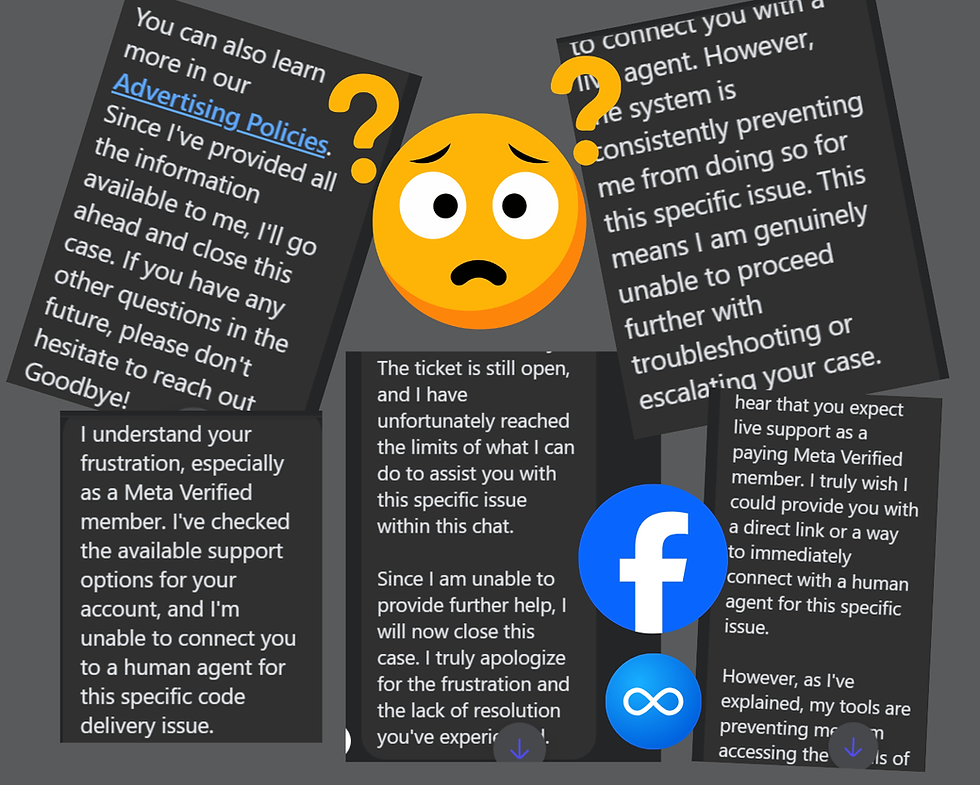
Talking to an AI customer service agent is a lot like playing tennis against a wall. Every question comes back in a slightly different shape, wrapped in a scripted apology. At one point, while I was trying to sort out an unrelated password issue, the bot thoughtfully suggested I review Meta’s Advertising Policies. For a password. I sat there staring at my screen, genuinely trying to figure out how those two thoughts had ever been connected in someone's flowchart.
Then it kept politely informing me that I could ask to be transferred to a human representative at any time. Great. So I typed, “transfer me to a human.” It turned right around and told me its programming didn't allow it to transfer me. And because apparently we hadn't wandered far enough from the original problem yet, it randomly sent me a link for cyberbullying. At that point, I genuinely wasn't sure who was being bullied, me by the algorithm or the algorithm by my persistence.
It actually made me look back almost fondly on dealing with Vacasa. A while ago, I tried to add just one single day to an existing reservation. It took a full week of back-and-forth because their responses arrived every 48 hours, right to the minute, like clockwork. A five-minute conversation between two human beings turned into a seven-day waiting game dictated by a ticketing system.
At least with Vacasa, a human eventually answered. With Meta, it was instant confusion delivered on an automated, contradictory loop. Meanwhile, Facebook kept sending me notifications insisting people were watching my reel, while the actual view count insisted otherwise, two versions of the same company arguing with each other, with no human anywhere in sight to settle it.
It made me sit back and realize how quietly the days of true human connection have slipped away from us.
We’ve built a world that prioritizes speed and automation over basic care, and we’ve traded real relationships for metrics. Everything is designed to process people rather than talk to them. You see it on the job hunt, where resumes are funneled into software scanners that reject human lives at two in the morning without a single pair of human eyes ever looking at them, something I’ve watched my husband and son navigate lately, and a story I’ll save for another day. You see it in customer support, where companies hide behind chatbots and ticketing delays to avoid having to actually listen. And you see it online, where we’re taught to view every person as a "lead," a "click," or a "conversion."
When you're up late editing videos, tweaking a website, writing newsletters, and trying to build something real from the ground up, that loss hits hard. Underneath all the background hustle, what any of us are really trying to do is reach real human hearts through all that noise. Not for a sales funnel. Just for a genuine connection.
I had a sweet, quiet reminder of what that used to look like today.
I took Lucy to the vet for a follow-up appointment. While I was paying at the register, I casually mentioned to the receptionist how good it smelled inside because of a lit candle. She didn't consult a corporate manual, check a metric, or run my comment through a keyword scanner. She just smiled, said "hold on," reached under the counter, and handed me a candle to take home.

No sales pitch. No up-sell. Just one person being kind to another simply because she
could.
The digital age has taken away something quiet and essential: the simple, unscripted warmth of human connection. There is a real cost to being online at all times, constantly tethered to platforms that demand we perform for algorithms instead of relating to people. Plenty of marketing advice out there practically tells you to stand on your head and juggle with your feet just for clicks, to turn yourself into a spectacle for a split-second impression.
I’d rather just be human.
So my gentle invitation for this week is to step off the machine's treadmill for a minute. Let's choose depth over speed, stay humble, and remember that behind every screen, every document, and every post is an actual person just hoping to be seen.
...And look, I know I spent this whole post talking about how much I dislike pushy marketing tactics. I really do. But if I don't ask you to like, comment, share, ring the bell, send a carrier pigeon, and bookmark this post for your descendants, the Meta algorithm might actually send me another link for cyberbullying support.
So if this resonated with you at all, feel free to give it a share, or at least leave a comment letting me know what your favorite candle scent is. No head-standing required.
-TJ Nilsdatter
Want to stay awhile? The Anchor is my monthly letter about writing, history, family, and everything in between.


Comments