


The Silent Service

Updated: May 5
The Silent Service: What No One Tells You About Loving a Submariner
Military Appreciation Month · May 2026
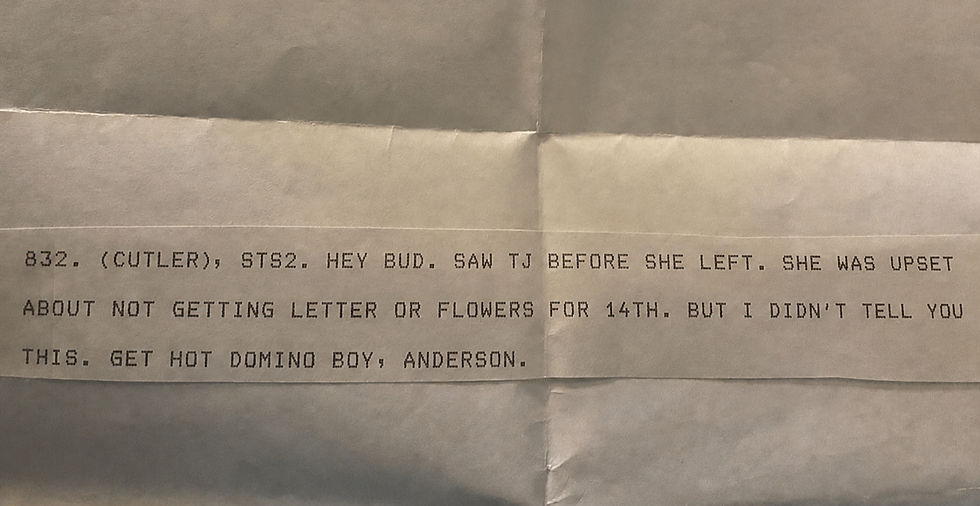
This is a family gram.
If you've never seen one, it looks like a telegram, because that's essentially what it is. A strip of typewritten text, all capitals, every word chosen carefully because you only got so many of them, and sometimes, there was a story there that didn’t fit in a family gram No punctuation to spare. No room for anything that wasn't essential.
This was how submarine families communicated thirty years ago. One way only. You wrote your words, submitted them, and hoped they made it through. No reply was coming. The boat was silent, and silence was the whole point.
Welcome to the Silent Service.
What Makes Submarines Different
Most people have a general picture of military deployment. Phone calls with bad connections. Care packages. Video chats that freeze at the worst moment. They know it's hard. What most people don't know is that there is a corner of the military where none of that exists.
When a submarine goes under, it goes dark. Not slower. Dark. This is the reality for submariners. It's what they train for. For weeks, sometimes months at a time, the families left behind simply wait without knowing where their person is, whether they are safe, or when they will surface again. And unlike the rest of the military, submarines are volunteer only. Every person on that boat chose to be there. Chose the silence. Chose the mission, and chose what that would mean for the people waiting at home.
To even serve on a submarine you have to earn it. Every submariner wears a pin called the dolphins, two dolphins facing a submarine, and earning it is one of the most demanding qualifications in the entire military. It requires mastering every system on the boat, being able to respond to any emergency, anywhere. You don't get handed the dolphins. You prove you deserve them. The people waiting at home know what that pin cost.

My husband served as a sonar technician out of Kings Bay, Georgia. In that time I learned what it means to live inside a silence you didn't choose but have to carry anyway. The family gram was our lifeline, and it only ran in one direction. Ironically, I think I easily adapted to modern texting due to the shorthand I learned sending family grams.
When the submarine was deployed you got used to it. You learned to rely on your community, the family members who knew exactly what you were going through. There was nobody to help you make decisions, you were on your own. Nobody to bounce ideas off of. Nobody to help with the chores. Nobody to comfort you when you were feeling alone, because you were alone. It was like living in an old movie with subtitles, everything moving around you, but the sound turned all the way down.
Days go by when you hope and pray they are doing okay. That they weren't working too hard. That they brought enough books to read. That they had enough snacks. The waiting is brutal. It messes with your head.
It is one of many sacrifices military families make quietly, without fanfare, and without being asked to.
It's Better Now. Mostly.
Today's submarine families have email. But the transition from family grams to actual phone calls was its own adjustment. My husband had a phone my parents gave him, a Star Trek phone, complete with a red alert ringtone. After months of silence, being jolted awake by a red alert at 2am was its own special kind of chaos. Progress, I suppose. The frequency still varies. There are still stretches of total silence, still deployments where communication goes dark for weeks, but the absolute blackout my generation lived with is less constant now.
And yet the fundamental truth of submarine life hasn't changed. You learn to live in the not-knowing. You learn to hold things together on your own, not because you signed up for it exactly, but because the person you love is doing something that matters, and this is your part of it. I know this not only because I lived it then, but because I am living a version of it now.

The day I dropped him off after boot camp, as he waited to ship out to submarine school. He is now stationed here in Washington, practically my own backyard, and the military still finds ways to remind you that close and reachable are not the same thing. The silence follows you. It just looks a little different than it used to.
What Submarine Families Carry
There is a specific kind of strength that develops in people who love someone in the Silent Service. It doesn't look dramatic from the outside. It's just the ability to keep going when you don't know where they are. To hold the family together when the other half of it is underwater and unreachable. To find the humor in a family gram that ends with "BUT I DIDN'T TELL YOU THIS."
The homecomings are something else entirely. But those stories belong to the book.
The Unbreakable Anchor is a multi-generational story about family, resilience, and the kind of love that keeps showing up, through deployments, through silence, through everything the Silent Service asks of the people left waiting on shore.
To every submarine family, past and present: the Silent Service runs on your strength too. Thank you.
— TJ Nilsdatter
Want to go deeper? The Unbreakable Anchor shares more of the personal stories behind the silence, the hardships, the waiting, and the homecomings. Join my newsletter to be the first to know when it's available.


Comments