


One Last Taste of Summer: Ribs, Football, and Feeding a Crowd

Fall has always been my favorite time of year. I love the crisp bite in the morning air, the heavy sweaters pulled from the back of the closet, and the quiet permission autumn gives you to slow down. But before fall officially takes over, we’ve always had a rule around here: you have to end summer with a bang.
In our world, that grand finale almost always involves a massive group camping trip, a ridiculous amount of smoked ribs, and a certain kind of “mojitos make fun happen” energy.
Now, if you want the actual story of what happened the night the mojitos took over the campground… well, you’ll have to wait to read that chapter in the book. Let’s just say some family legends are earned in real time, usually under tall pines with someone trying to keep a straight face, and they deserve every single page they take up in The Unbreakable Anchor.
There is something about ribs on the grill that makes me actually forgive summer for its heat. Maybe it’s the rich ribbon of woodsmoke drifting through the campground before dinner. Maybe it’s the barbecue sauce that inevitably ends up on knuckles, cheeks, and picnic table benches. Or maybe it’s just the fact that ribs have never been a quiet, ordinary Tuesday night meal for us. They don’t show up for convenience. Ribs show up when people gather.
And in our family, food isn't just fuel, it is the living heartbeat of every single gathering, especially when we’re out in the woods.

Years ago, for his birthday, I bought my husband Alex a smoker. It wasn’t a sleek little patio gadget; it was a massive, heavy Weber charcoal smoker that had to be practically disassembled into individual metal components just to wedge it into the back of the truck alongside the tents and coolers. That heavy metal drum has been an unwitting character in half our family lore. Over the years it has been hauled across the pass to state parks and riverbanks, but the best excuse Alex ever found to lug it anywhere was when he had an audience to mentor in the ancient, patient art of smoking meat.
Our annual late-summer run to Eastern Washington, out toward a spot called Blu Shastin, was the proving ground. Whenever there wasn’t a burn ban in effect, Alex would fire up the coals and set to work turning boys into pitmasters. They’d gather around that drum like it was a sacred hearth, mesmerized by the smoke rings, the vents, and the slow transformation of meat over hours of quiet patience.
Originally, it was just our boy and a couple of buddies hanging around with paper plates in hand. But year by year, that trip kept snowballing until Alex was suddenly presiding over an entire varsity football team, teaching teenagers how to time the wrap and watch the heat. Teenage boys carry an appetite that defies all laws of physics. If you put them through two-a-days and conditioning in the summer heat, you’d better be prepared to feed them like lumberjacks when they walk through camp.
Ribs were built for that kind of crowd.
They aren’t an elegant meal. Nobody eats ribs gracefully, and that’s precisely why they work. There are mountains of paper towels that immediately turn translucent from grease, sticky fingers, and people eyeing the platter for “just one more bone” five minutes after groaning that they couldn't eat another bite. The best part was watching the high school girls who somehow always managed to gravitate toward the campsite where the football players were gathered. They’d arrive attempting to look cool, poised, and detached—right up until the platter hit the table. Within twenty minutes, all pretenses had vanished, and every one of those girls was sitting on a camp chair with barbecue sauce smeared across their grins just like the rest of the crew.
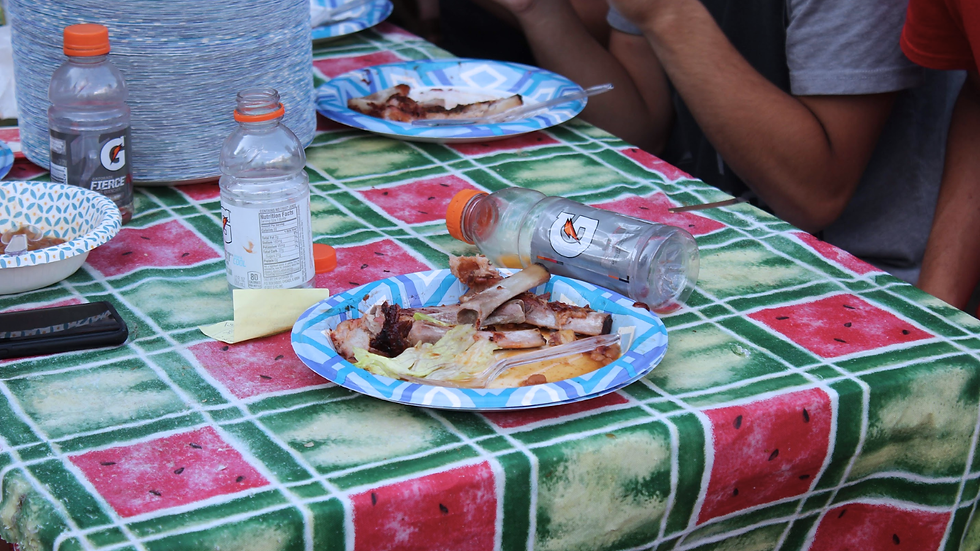
Maybe that’s what makes ribs the ultimate gathering food: you can’t protect your dignity while eating them, so you might as well relax and enjoy the crowd.
When I look back at my favorite memories, very few of them belong to grandiose milestones or perfectly staged events. They happened around scarred wooden picnic tables, leaning against the tailgates of trucks, sitting shoulder-to-shoulder on camp cots, or crammed into a kitchen where everyone is elbowing each other for counter space.
The meal itself rarely felt historical in the moment. You were just hungry, and the food was good.
Years later, though, that meal is the anchor that pulls the whole day back to the surface. You remember the exact smell of pine needles heating up in the midday sun. You remember who was sitting across from you. You remember Alex squinting through the woodsmoke with a set of tongs in his hand. You remember laughing until your ribs hurt over an inside joke that probably wouldn't make sense to a single soul outside that circle of camp chairs.
Food has an uncanny way of becoming part of the permanent record of our lives.
That’s why food and recipes belong right alongside the stories I tell. Family history isn’t locked away strictly in official courthouse ledgers, black-and-white portraits, or branches inked across a pedigree chart. It lives in the dog-eared index cards tucked inside an old metal recipe box. It lives in the dish everyone demands at the holidays, or the breakfast someone’s dad made on the camp stove every July without fail.
Sometimes, family history is just an absurd amount of meat on a charcoal smoker.
September has always felt like a doorway between two worlds. The summer sun hasn’t fully packed its bags yet. The afternoons are still golden and warm, perfect for keeping the grill going while the sun dips behind the trees. But the mornings have that familiar sharpness. The dusk comes an hour earlier. High school stadium lights are humming on Friday nights. In just a couple of weeks, the heavy Dutch ovens and slow cookers will take over the counter, the house will fill with the smell of simmered beef and chili, and everything we make will lean into autumn.
Before we officially trade the smoke for the stew pot, this feels like the right moment to pass along one last taste of summer.
These baby back ribs have carried us through long camping weekends, football seasons, and countless rowdy tables full of kids who grew up way faster than we were ready for.

And I’m finally writing down the way Alex makes them.
Pinning Alex down for exact measurements was a small exercise in comedy. Like most people who have spent years cooking over open coals, his primary measuring tool is his own two eyes.
“How much mustard, Alex?”
“Enough to coat it, TJ.”
“Okay, but how much rub?”
“Until it looks right.”
Invaluable advice if you’ve tended a hundred racks of ribs; mildly exasperating when your wife is sitting with a notebook trying to translate instinct into a recipe people can actually replicate at home.
Don't fret over exact fractional teaspoons here. The technique, the classic 3-2-1 slow roll, is what matters.
Alex’s Smoked Baby Back Ribs
The Ingredients
2 racks baby back ribs (membrane removed from the back)
Approx. ¼ cup yellow mustard (just enough for a thin binder)
¼ to ⅓ cup of your favorite barbecue rub (generously applied)
1 to 1½ cups of your favorite barbecue sauce, plus extra for basting
The Method
Preheat the Smoker: Bring your smoker up to a steady 275°F to 300°F with your choice of wood (apple or hickory works wonders here).
Apply the Binder: Brush a thin, even coat of plain yellow mustard over both sides of the racks. You won’t taste mustard when it's done—it simply gives the spices something tacky to grab so they don't slide off.
Season Generously: Dust the ribs all over with your dry rub until they have an even, textured crust. Let them sit for 10–15 minutes until the rub looks wet.
The First Smoke (3 Hours): Place the ribs directly on the smoker grate, meat side up. Close the lid and let the smoke do the work for 3 hours undisturbed.
The Wrap (2 Hours): Pull the ribs off and wrap each rack tightly in a double layer of heavy-duty foil (crimp the edges tight to trap the steam). Return the wrapped bundles to the smoker for another 2 hours. This is where they turn fork-tender.
The Glaze & Finish (1 Hour): Carefully peel back and discard the foil. Brush a thick, glossy coat of barbecue sauce over the top of the ribs. Lay them back on the grates, uncovered, for the final hour so the sauce can caramelize into a sticky lacquer. Brush on a second coat about 20 minutes before pulling them off if you like them extra saucy.
Alex usually grabs whatever sauce we happen to have on hand, though on special occasions he’ll whip up a batch of his homemade raspberry chipotle sauce. That recipe, however, is staying locked in the family vault for now. For tonight, grab the ribs. And make sure you pull out twice as many napkins as you think you need.
I hope that future generations can tell that people were fed here, not just nourished, but welcomed. That there was always room for another folding chair around the circle. That laughter was loud and summer nights were spent outdoors with the stars fighting the campfire for light. Those messy, everyday rituals are so easy to take for granted while your hands are still sticky with sauce and you’re trying to pack up a truck before sunset. But when you step back, those are the exact moments that stitch a family’s story together.
Preserving a family legacy can mean digging through archives and piecing together ship manifests from across an ocean. And sometimes, it’s as simple as making sure the rib recipe doesn't get lost.
Want to stay connected beyond the blog?
Sign up for my monthly newsletter, The Anchor, where I share life updates, what I’m working on, book news, and a new collectible bookmark each month. Pull up a chair and join me at the table.
-TJ Nilsdatter


Comments