


Hearth, Hardship, and Knoephla: How Food Forged Community in the Early Dakotas

Updated: 5 days ago
To understand life in the Dakotas at the turn of the twentieth century is to understand endurance. The plains were vast, beautiful, and unapologetically harsh. For the wave of settlers staking claims across North and South Dakota in the early 1900s, survival wasn't an abstract ideal. It was measured in cords of wood cut before November, bushels of potatoes stored deep in root cellars beneath the frost line, and the resilience of a tight-knit community.
The land demanded everything. Settlers contended with brutal winter blizzards that buried claim shacks to their eaves, blinding summer dust, sudden prairie fires, and illnesses like influenza and diphtheria that traveled faster than doctors could reach rural claims. On the largely treeless prairie, even keeping a stove burning required ingenuity. Families sometimes burned twisted prairie hay, corncobs, or dried manure when firewood was scarce.
Between the Second Dakota Boom and the expansion of the northern transcontinental railroads, the prairie filled with an extraordinary blend of cultures. Norwegian, Swedish, Danish, German, and Austrian immigrants established homesteads across the Dakotas, bringing generations of agricultural knowledge, family traditions, and a strong sense of community.

Communities coalesced around two primary sanctuaries: the church and the kitchen table. In some settlements, immigrants preserved the language and liturgy of the old country, and Lutheran and Roman Catholic congregations maintained their own close-knit traditions. Yet survival on the prairie demanded cooperation. Neighbors helped neighbors raise barns, thresh grain, and dig graves in frozen soil.
During harvest, women prepared enormous meals for traveling threshing crews, sometimes feeding workers five times a day. Meanwhile, root cellars filled with potatoes and vegetables, and kitchens bustled with pickling, preserving, and preparing for the long winter ahead. Feeding a family was no small undertaking, and the labor performed inside the home was every bit as essential as the work in the fields.
In Regina's journey in the Sunstone Path, this frontier reality takes center stage. From the bustling railroad neighborhoods, to the open prairie homesteads, she encountered a world where immigrants carried their traditions from one home to the next. She learned that while language might falter across property lines, food was an immediate, common vernacular. Recipes traveled with families, adapted to new circumstances, and became part of the next generation's inheritance.
Among those traditions, carried forward to my grandmother, was a simmering kettle of Knoephla Soup.

Pronounced “NEF-la” (from the German Knöpfle, meaning "little buttons"), this thick, creamy dumpling soup became a beloved staple of German-Russian prairie cooking. Its humble ingredients reflected the realities of immigrant life: root-cellar potatoes, flour, milk, and whatever fat could be spared. When the autumn prairie winds turned bitter, a pot of Knoephla simmering on a cast-iron stove could stretch modest pantry staples into a meal rich enough to sustain a family after ten hours in the fields.
Traditionally, the dumplings were made from a simple dough, rolled into ropes and snipped into small pieces before being dropped into simmering broth. Like so many immigrant recipes, each household developed its own variation, shaped by available ingredients and generations of family tradition.
Over the decades, Knoephla has evolved, picking up aromatic herbs, sweet root vegetables, and smokiness from bacon while retaining its pillowy dumpling core. It remains the ultimate ode to autumn: hearty, grounding, and steeped in the grit of the women who built homes out of sod and hope.
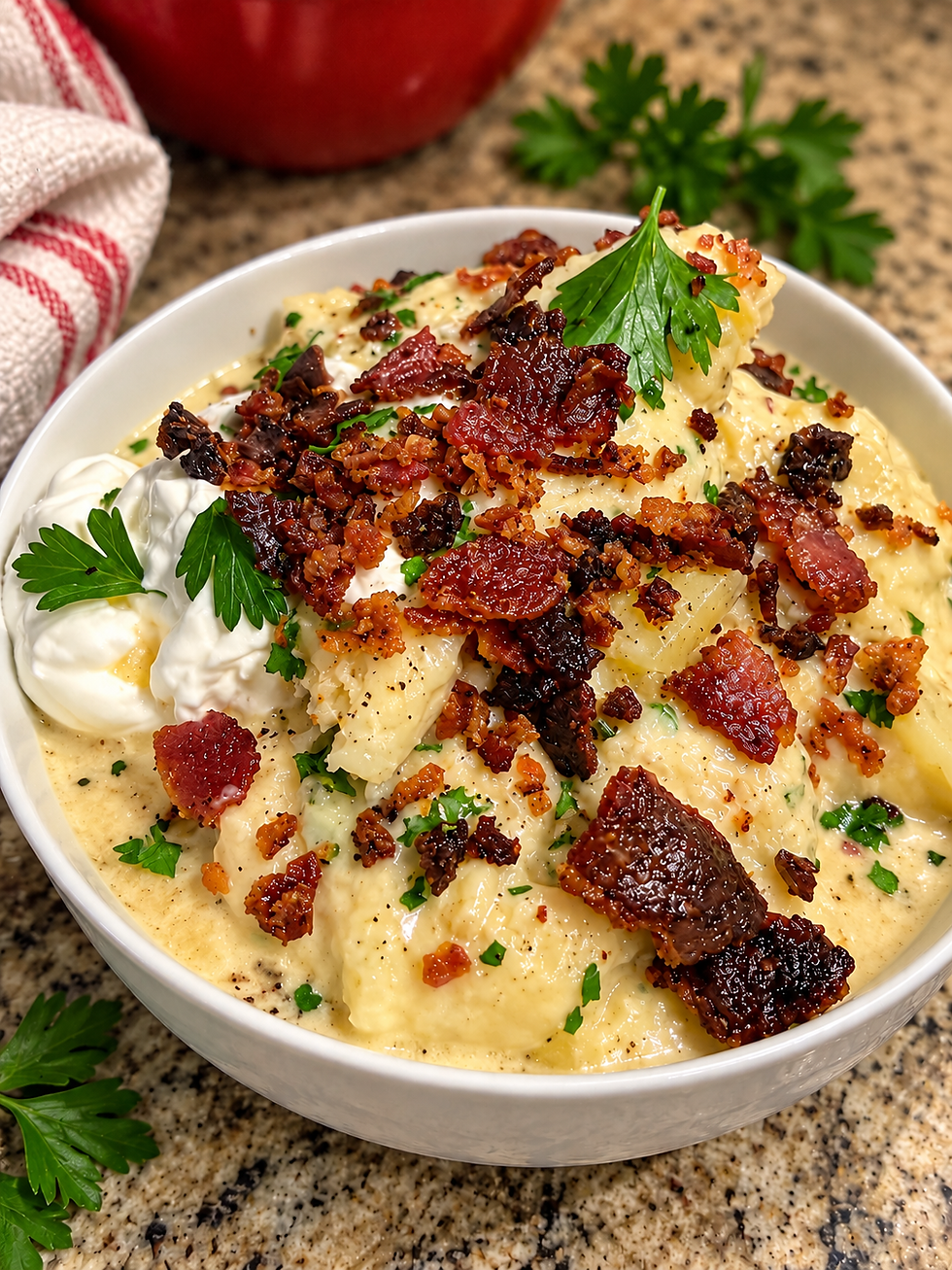
Prairie-Style Knoephla Soup
A rich, creamy potato soup laden with tender, herb-flecked dumplings. Hearty, nostalgic, and built to warm you to your boots.
Prep time: 25 mins
Cook time: 35 mins
Servings: 6 to 8
Ingredients
The Soup Base
4 slices thick-cut bacon, chopped (or 2 tbsp butter for vegetarian)
4 tbsp unsalted butter
1 medium yellow onion, finely diced
2 medium carrots, peeled and diced
2 stalks celery, diced
3 cloves garlic, minced
1/3 cup all-purpose flour
6 cups low-sodium chicken broth (or vegetable broth)
3 cups Yukon Gold potatoes, peeled and cut into 1/2-inch cubes
2 dried bay leaves
1 cup heavy cream
Kosher salt and freshly cracked black pepper, to taste
The Dumplings (Knoephla)
1 cup all-purpose flour
1 tbsp baking powder
1 tsp kosher salt
1 tbsp fresh parsley, finely minced
1 tbsp fresh dill, finely minced
1 tsp fresh thyme leaves
1/2 cup whole milk
1 large egg, lightly beaten
Instructions
Step 1: Crisp the Bacon & Sauté the Aromatics
In a large Dutch oven or heavy-bottomed stockpot, cook the chopped bacon over medium heat until browned and crisp (about 6–8 minutes). Remove the bacon with a slotted spoon and set aside, leaving the drippings in the pot.
Melt the butter directly into the bacon drippings. Add the diced onion, carrots, and celery. Sauté over medium heat for 6 to 8 minutes until the vegetables soften and the onions turn translucent. Stir in the minced garlic and cook for about 60 seconds until fragrant.
Step 2: Build the Broth
Sprinkle the 1/3 cup of flour evenly over the sautéed vegetables. Cook, stirring constantly, for 1 to 2 minutes to cook out the raw flour flavor.
Slowly pour in the chicken broth, whisking constantly to prevent lumps from forming. Add the cubed potatoes, bay leaves, 1 teaspoon of kosher salt, and 1/2 teaspoon of cracked black pepper. Bring the soup to a boil, then reduce the heat to medium-low, cover partially, and simmer for 12 to 15 minutes, until the potatoes are just fork-tender.
Step 3: Mix the Dumpling Dough
While the soup simmers, prepare the dumplings. In a medium bowl, whisk together the flour, baking powder, kosher salt, parsley, dill, and thyme.
In a separate small measuring cup, whisk the milk and egg together. Pour the wet ingredients into the dry ingredients and stir with a wooden spoon or fork just until combined. (The dough should be sticky, soft, and drop-able. Do not overmix, or the dumplings will become dense.)
Step 4: Drop the Dumplings & Simmer
Remove the bay leaves from the simmering pot.
Using two small teaspoons (or a small cookie scoop), drop small, bite-sized portions of batter (about the size of a marble or hazelnut) directly into the gently simmering soup. Dip your spoons into the hot broth occasionally to keep the dough from sticking.
Once all the dough is dropped, cover the pot with a tight-fitting lid and simmer undisturbed over low heat for 8 to 10 minutes. The dumplings will float to the top and plump up considerably.
Step 5: Finish and Serve
Stir in the heavy cream and reserved crispy bacon. Let the soup warm through over low heat for 2 to 3 minutes without letting it reach a rolling boil.
Taste and adjust seasoning with additional kosher salt and cracked black pepper as needed. Ladle into warm bowls and garnish with extra fresh dill or parsley. Serve immediately.
Historical & Baker's Notes
Traditional vs. Drop Dumpling: Traditional German-Russian Knoephla dough was often rolled into thin ropes and snipped directly into the pot with kitchen shears to form small buttons. This drop-batter variation yields a lighter, fluffier dumpling that readily absorbs the savory cream broth.
A Note on the Dough: The dough should be soft and pliable, slightly tacky but not sticky. Add the milk gradually, using only as much as needed to bring the dough together. If it becomes too wet, work in a little additional flour until you can comfortably knead, roll, and cut it into small pieces. Let the texture guide you rather than relying strictly on measurements.
Potato Choice: Yukon Golds are ideal because they hold their neat cubical shape through simmering while releasing just enough starch to enrich the broth's silkiness.
The recipes our ancestors carried across oceans were more than a way to put food on the table. They were reminders of home, adapted to new ingredients, shared with neighbors, and passed from one generation to the next. A simple bowl of Knoephla Soup tells a story of hardship, resourcefulness, and the communities built around a common table. More than a century later, those traditions still have a place in our kitchens.
The stories don't end at the table. Subscribe to The Anchor, my monthly newsletter, for more family history, immigrant traditions, and a behind-the-scenes look at the stories inspiring my historical fiction series, Before the Anchor.
-TJ Nilsdatter



Comments