


The Magic City: The Prairie that Shaped a Family

Updated: Jun 6
My grandmother rarely talked about her childhood. What I learned about where my family started in America came from stories overheard at the kitchen table: my dad and uncle trading memories while my grandmother’s musical laughter filled the room and my grandfather’s annoying chewing habits provided the soundtrack.
The stories were always the same at their core: The endless drive from Marysville, Washington to Minot, North Dakota. Towering mountains and evergreen forests slowly gave way to the open prairie beneath an even bigger sky. The plains had their own quiet beauty, one I would only come to appreciate much later, but to two boys trapped in the backseat for endless hours, the Magic City was anything but magical.
It wasn’t until I was much older that I started to understand why the place stayed with them.
Years later, driving across the endless corn fields of Iowa myself, I finally understood part of what my father had tried to describe all those years. The prairie has a way of distorting time. The horizon barely changes. The road keeps unfolding endlessly ahead of you, mile after mile of open land that feels both beautiful and isolating at the same time. Somewhere in those long stretches of highway, I began to understand the Dakota plains a little better.
The Dakotas could not have been more different than the fjords of Norway where so many immigrant families had come from. There were no similarities at all: not the climate, not the scenery, not the land itself. It was a harsh and unfamiliar world. Wheat fields stretched toward horizons so wide they barely looked real. The wind never stopped moving. In the Souris River Valley, the carved-out valley floor and rising plateaus made the landscape feel almost lunar, ancient and impossibly open.
And yet people came. They stayed. They built something.
That tension became one of the foundations of The Sunstone Path.

The series follows several lives shaped by the Dakota plains, including Albert and Edvard, two Norwegian brothers trying to build a future outside Minot during the railroad expansion that transformed the region almost overnight. While Albert experiences the rough edges of frontier Minot firsthand, other characters in The Sunstone Path experience the prairie very differently, through family, faith, survival, silence, and the impossible choices that shaped immigrant life.
Minot earned the nickname “The Magic City” in the late 1800s when the Great Northern Railway pushed westward and the town seemed to materialize from the prairie by sheer force of ambition. Like many frontier towns, Minot developed a rough reputation early on. Railroad workers, land speculation, vice, violence, and rapid expansion created a city that could feel lawless at times. From 1905 to 1920, Minot’s population exploded alongside railroad construction and waves of settlement, while court records documented widespread criminal activity throughout the region.
Then came Prohibition, and things became even wilder.
Minot turned into a supply hub connected to liquor smuggling routes running south from Canada. Bootlegging, prostitution, speakeasies, and opium dens flourished in the city’s underground economy. Smugglers reportedly used tunnels beneath parts of downtown to move illicit cargo through the city, earning Minot a second nickname: “Little Chicago.”
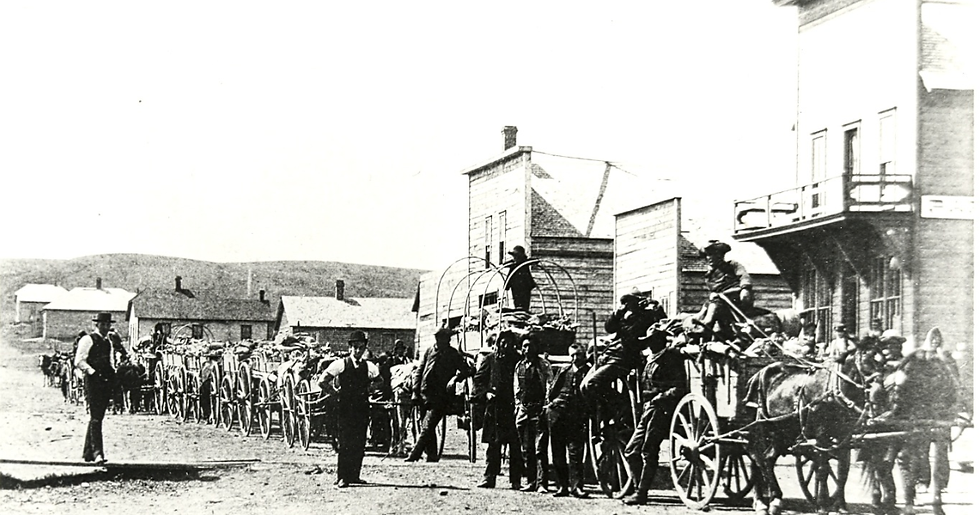
This photograph, taken in early Minot, shows wagons that are not loaded with goods or supplies. They're piled high with buffalo bones.
By the time settlers and railroad workers arrived on the Dakota plains, the great buffalo herds had been nearly wiped out. What remained were bones, millions of them, scattered across the prairie as far as the eye could see. Settlers and homesteaders collected them by the wagonload and sold them to eastern factories to be ground into fertilizer and made into carbon black for refining sugar. A single ton fetched just a few dollars. Men made entire livings from it.
It is one of the stranger and more haunting details of frontier life. The same land being broken open for farms and railroads and cities was also being picked clean of what had sustained the Plains peoples for thousands of years. Minot was being built on ambition, yes, but also on bones.
What fascinates me most is not just the criminal side of that history, but the contradiction sitting beside it.
While bootleggers operated beneath the surface, churches were being built above ground. Families established farms that lasted generations. Scandinavian immigrants carved communities out of the plains and built lives sturdy enough to survive brutal winters, isolation, crop failures, and time itself. The Magic City was building its future on both ambition and vice. There is something deeply human about that.
Albert experiences that version of Minot firsthand in The Sunstone Path. His first Fourth of July in the city captures the raw energy of a frontier town still trying to decide what kind of place it wanted to become:
In the Magic City, the festivities didn’t wait for the sun; gunshots cracked against the dawn, the reports ricocheting off raw timber and false-front buildings that looked as though they had been exhaled from the prairie dust overnight. It was a town built on the frantic architecture of hope and gunpowder, where the American dream didn’t just arrive, it exploded into being.
Albert and Edvard end up spending part of that Fourth of July in the Minot jail, the story of how they got there is one for the book, but sitting in that cell, Albert reflects on everything he had already sacrificed to build a life there:

The iron bars of the Minot jail cast striped shadows across the floor, smelling of stale tobacco and the copper tang of blood still drying on Edvard’s knuckles. Albert sat on the edge of the cot, the silence of the cell heavier than the humid July night.
“I should’ve stayed in Norway,” he said, the sarcasm thin over a raw layer of exhaustion.
But even as he said it, he knew it wasn’t true.
That line may sum up the immigrant experience better than any history book ever could.
Minot continued reinventing itself long after those early frontier years. The Air Force base transformed the city into an important military community during the Cold War. The Bakken oil boom reshaped western North Dakota once again in the twenty-first century. Scandinavian heritage festivals still celebrate the immigrant roots that helped build the region in the first place. The city that sprang from railroad tracks and prairie dust never really stopped changing.
But beneath all those reinventions, the prairie remains the same.
Maybe that is why Minot continues to pull at my imagination despite being a place I know mostly through stories, research, and inherited memory. Some places become part of a family long before you ever stand there yourself.
The Magic City, in the end, was never really about perfection.
It was about survival.
The story of Albert, Regina, and the families shaped by the Dakota plains continues in The Sunstone Path, scheduled for release 2027.


Comments