


The Quiet Therapy of Pets

"A longtime tradition in my family while camping was going for walks around the campground. Since the group camp is across the main road from the actual campground, it was a bit of a walk to get down to the nature loop and the river. We decided to make the trek as one giant pack. Everyone we passed stopped and stared as we walked along with all twenty-five dogs."
That scene sits in the pages of The Unbreakable Anchor, but it also sits in my childhood exactly as it happened. It wasn't written because it made a good story. It made a good story because it was normal to us. Twenty-five dogs walking down a gravel road toward the river, parents and grandparents and aunts and uncles and cousins all trailing behind, and enough wagging tails to make strangers stop in their tracks wondering what on earth they were looking at. We'd smile, keep walking, and think absolutely nothing of it. Every collar clinking, every leash tangled with three others, someone always yelling for a dog that had wandered off toward the river a beat too early. It probably looked like chaos from the outside. From the inside it just looked like family. Of course there were twenty-five dogs. There were always dogs.
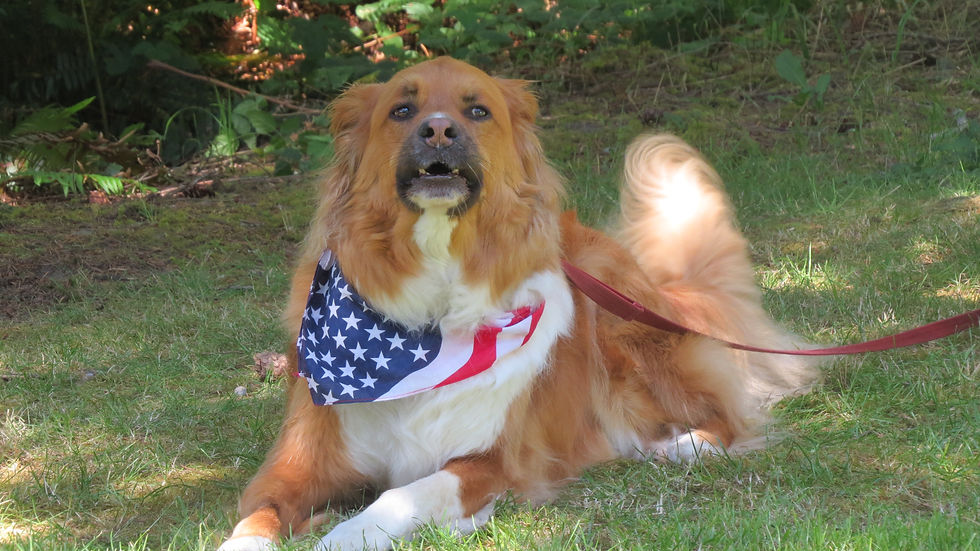
When I look back on my childhood, I don't remember a family that happened to own pets. I remember a family that built its life around them. My dad had a Pomeranian who somehow ruled the house despite weighing less than a bag of flour. We had a gentle German Shepherd and Golden Retriever mix who immediately took on the role of guardian of the family, quietly positioning himself between us and anything he thought might be a threat, one time that happened to be a park ranger with a weed whacker. We had cats, rabbits, hamsters, fish, and just about anything else that wandered into our lives and decided to stay.
One of my earliest pets was a little bunny named Fufu. While most kids walked puppies around the neighborhood, I proudly walked my rabbit on a leash without ever questioning whether that might be considered odd. Fufu seemed perfectly content hopping beside me, and I was perfectly content pretending that every bunny in America probably went for afternoon walks. My grandpa eventually built a beautiful wooden hutch for my rabbit, and then got me a companion for her. The only problem was that he was a far better carpenter than he was at identifying rabbits. He assured us we had two females. We didn't. Before long, two rabbits somehow became ten. Instead of frustration, it became another family story, another memory we'd laugh about years later, because around our family, animals always seemed to have a way of multiplying, and somehow we always found room for one more.
Grandpa was ahead of his time in more ways than one. Long before anyone had heard the word "catio," he built one. Most people bought scratching posts. Grandpa converted an entire six car garage into a playground for his cats, with ladders climbing to lofts, shelves stretching across the length of the garage, window perches, homemade toys, hiding places, and more room than some apartments. Today people proudly show off elaborate catios online. Grandpa quietly built one sometime back in the eighties simply because he loved his cats and thought they deserved it. He never once called it impressive. He just called it theirs.
Then there was Gizmo, the first pet that was truly mine. When I got married, he stayed behind with my parents, where he continued proving that cats possess a remarkable talent for finding the worst possible places to nap. One afternoon my mom had left the dryer door open while folding laundry, and Gizmo climbed inside, curled up on the warm damp clothes, and fell fast asleep. Not knowing he was there, Mom shut the door and started the dryer. A few seconds later she heard a thump, then another, then another, and certain she'd accidentally left a shoe inside, she quickly opened the door. Instead, out leaped what she later described as the fluffiest cat she'd ever seen. Gizmo trotted away looking mildly annoyed by the whole experience, and somehow that ridiculous story has survived in our family almost as long as he did. Some stories earn their place in family lore just by being told enough times, and that one earned it fair and square.
Those are the kinds of memories I find myself returning to lately. Maybe it's because my little pug, Lucy, has spent the last couple of weeks fighting vestibular syndrome. Watching her stumble, worrying over every meal, every nap, every small improvement, has a way of putting your heart on constant alert. It also has a way of sending your mind backward through every animal who ever left paw prints on your life. You start reaching for the old stories because the new ones feel too fragile to sit with for very long.

Throughout The Unbreakable Anchor, I lean on my pugs more than almost anyone else in the book, and each one of them earned that place in their own particular way. Charlie was a rescue, thirty pounds when we got him, and he used to howl in the car straight up like a beagle, which remains one of the funniest things I have ever heard come out of a pug's mouth. Buddy was the gentlest and the funniest of them all. He had a great "love" in his life, his giant stuffed turtle that was bigger then he was. He was the pug who lived through three toddlers and never once made a sour face, not when they pulled his tail, not when they pulled his ears, not when they colored on him or buried him halfway in the sandbox. He took all of it in stride. He was also a stinker in the best way, the only pug I've ever had who wanted to play catch me if you can, tearing through the house just to see if you'd chase him. He was, in a very real sense, my workout routine.
Then came Molly and Lucy. They never tried to replace the dogs who came before them. They simply became themselves. Lucy is attached to me in a way that goes beyond ordinary dog devotion. She has to be near me, touching me in some form, at all times. She used to perch on the back of the couch like a cat, watching over the room from up high. She is fiercely food motivated and barks relentlessly the moment dinner time approaches, refusing to let anyone get off schedule. She's independent too, in her own contradictory way, only letting you pet her when she decides she feels like it, and more nights than not I find her curled up on the back of my neck while I sleep. Molly is the sweetest, most gentle pug we have ever had. She loves camping, and more than that she loves having the whole family together. Nothing makes her happier than everyone being in the same room at once. A few years ago she got a Grinch toy for Christmas, and she has carried it around ever since, looking for it every night before bed and sleeping cuddled up against it. She never complains about anything. She is always curled up at my feet. She is an example of resilience, never faltering in spite of her special needs. She is a role model for all the humans that surround her.

There is no version of my adult life that doesn't have one of these dogs somewhere in the frame, and not in the background either. Right up front, usually taking up more than their fair share of the bed.
"I whispered 'I love you,' my voice cracking as I hung up the phone, and I sat there in the dark, the only sound in the house being the rhythmic, oblivious snoring of the pugs who were both up on the bed, nestled in my lap."
That's another moment from The Unbreakable Anchor, and it's part of why the title means what it does. This quote is from a scene in the book through one of the toughest moments in my life. When I began writing my memoir, I thought I was tracing the people who anchored our family through life's storms. Somewhere along the way I realized I had overlooked the four legged members of that crew.
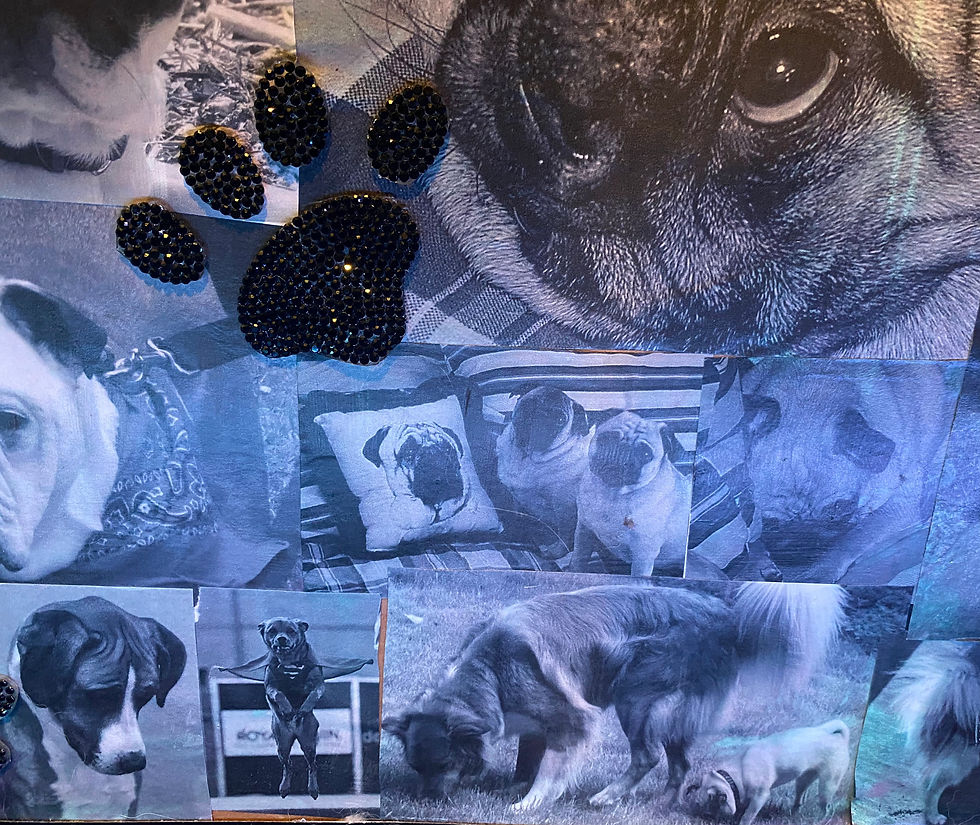
Behind my desk hangs one of my favorite things in our home, a wall I made, a collage, of black and white portraits, one photograph for every dog who has been part of our family. Some of those faces crossed the rainbow bridge years ago. Some are snoring in the next room as I write this. A few still need to be added, because like every family tree, this one is never really finished. Sometimes I catch myself standing in front of that wall longer than I intended, because every face represents a chapter, a season, a memory, a piece of home. I've started to notice that I don't look at that wall the way I look at other photographs. There's no posed smile to critique, no bad lighting to wish away, just a face that once leaned into my hand exactly when I needed it to.
From twenty-five dogs wandering through a campground, to rabbits multiplying faster than the speed of sound, to cats climbing homemade lofts, to one extraordinarily fluffy cat emerging from a dryer, to a howling rescue pug and his gentle turtle-loving best friend, to the two who are with me now, one perched on the back of my neck and one curled around a well-loved Grinch, I can't imagine my story without them. They've been woven through every chapter. They've celebrated beside us, grieved beside us, grown old beside us, and loved us without ever asking for an explanation. Some people collect photographs of places. Some collect souvenirs. Apparently, my family collected animals, and looking back now, I don't think we could have built The Unbreakable Anchor without them.
Some of the strongest anchors in our family's story never said a single word. They just kept showing up, paw on the knee, snore on the pillow, a warm weight against your leg on the nights you needed it most. That's the whole secret, really. They never needed the big gesture. They just never left.
Some anchors walk on two legs, and some on four. Their paw prints can be found throughout The Unbreakable Anchor, arriving this fall.
Subscribe to my newsletter and be the first to hear about the book's release, new blog posts, and everything happening in the world of TJ Nilsdatter.


Comments