


Steel Rails West: How the Railroads Reshaped the Northern Plains

Deep diving into history is one of the benefits of writing a historical novel. History is a passion of mine, and what I have discovered about the lives my great-grandparents led sometimes makes current-day struggles seem trivial. One of the most powerful forces shaping the world they lived in was the railroad. Nowhere was its impact more profound than across the northern plains, where the railroads transformed communities, economies, and everyday life, bringing extraordinary opportunities alongside consequences that were not always for the better.
When my great-grandmother arrived in St. Paul, Minnesota, in 1902, she stepped into a world being transformed by the railroad. James J. Hill's Great Northern Railway already stretched from St. Paul across the northern plains and through the Cascade Mountains to Puget Sound, while the Northern Pacific followed its own transcontinental route farther south. But the great railroad expansion was far from over. New branches continued reaching into agricultural communities, towns competed desperately for rail connections, and rival companies fought for freight, passengers, and territory. Within a few years, the Milwaukee Road would begin pushing its own line west toward the Pacific, and more than a decade after my great-grandmother arrived, farmers around Veblen, South Dakota, would still be investing their own money to bring a railroad to their community.

At the center of the northern expansion was James J. Hill, the Canadian-born railroad executive who became known as the "Empire Builder." Hill and his partners had taken control of the struggling St. Paul and Pacific Railroad in the late 1870s, reorganized and expanded it, and eventually created the Great Northern Railway in 1889. Unlike several other western transcontinental railroads, the Great Northern was built without federal land grants, making the development of profitable traffic along its route especially important. Hill needed more than tracks across the prairie. He needed people living beside them, producing goods his railroad could carry and buying goods his trains could bring west.
The Great Northern actively promoted settlement along its route, advertising farmland to prospective homesteaders and immigrants in the United States and Europe. Families packed their belongings into inexpensive "colonist cars," often equipped with hard seats and simple cooking facilities, and rode west toward land being promoted as an opportunity for a new life. Farmers produced the wheat and livestock Hill's trains could carry east, while those same families needed lumber, machinery, manufactured goods, and household supplies carried west. The railroad wasn't simply serving communities that already existed. Even in the early twentieth century, the expanding network continued to influence where people settled, where towns grew, and which communities gained access to national markets.
Where those tracks landed, the transformation could be astonishing. Minot, North Dakota, provides one of the clearest examples of what Hill's expanding railroad could do to a place almost overnight. In 1886, construction of Hill's railroad reached the area and stopped for the winter, bringing thousands of railroad workers into what had been open prairie. A settlement grew with such speed that Minot became known as the "Magic City." The raw new community quickly acquired the saloons and gambling establishments that so often followed large populations of transient laborers. The railroad didn't simply connect Minot to the rest of the country. It was the reason the city developed where and when it did.
Farther east, Fargo and Moorhead developed on opposite banks of the Red River, where railroads, agriculture, immigration, and commerce converged. Their relationship became particularly interesting after North Dakota outlawed alcohol while Moorhead remained wet. By 1900, Moorhead had forty-seven saloons serving a population of only 3,732. Some establishments clustered near the bridges specifically to attract customers from Fargo, and saloons even operated horse-drawn "jag wagons" that carried Fargo residents across the river to drink. The Red River had become more than a state boundary. It separated dry North Dakota from a booming liquor trade on the Minnesota side, demonstrating another way borders, railroad traffic, and rapidly growing towns combined to create economies that would have been almost unimaginable only a generation earlier.
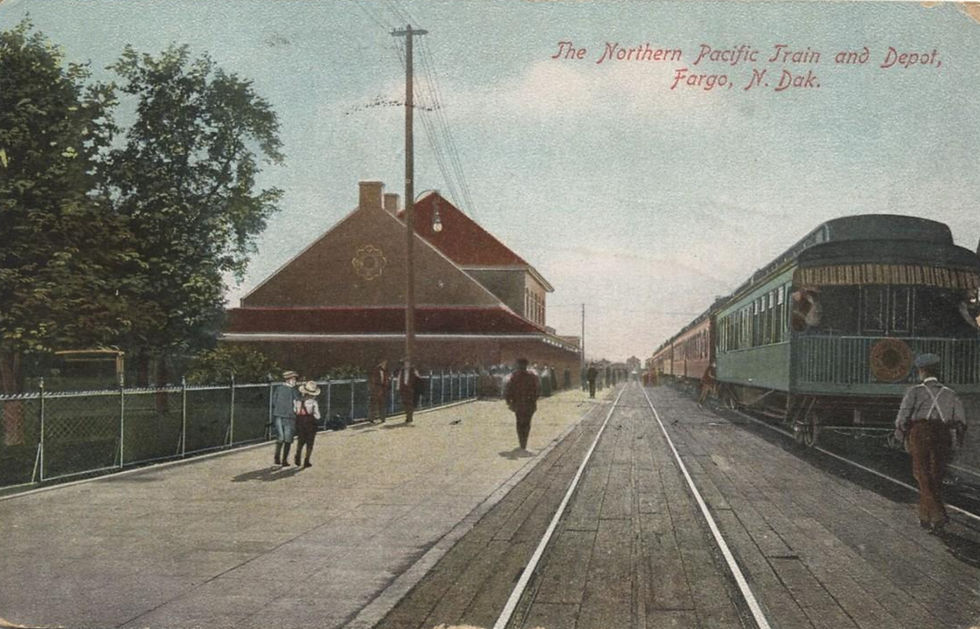
The Northern Pacific created its own string of important communities farther south. Bismarck became a critical Missouri River crossing and transportation center after the railroad reached the area in the 1870s. Farther west, the Northern Pacific reached Miles City, Montana, in 1881, linking an already rough frontier settlement near Fort Keogh to eastern markets. Miles City's saloons, dance halls, and bordellos served a transient population that included soldiers, buffalo hunters, bullwhackers, muleskinners, and cowboys. With the railroad came another transformation: cattle. Herds were driven to Miles City from great distances because the Northern Pacific could carry livestock directly to eastern markets, helping turn the town into an important cattle-shipping center. Fans of Larry McMurtry's Lonesome Dove may recognize Miles City and its place in the cattle-driving history of the American West.
Then there was Lemmon, South Dakota, which belonged to yet another railroad empire. The Milwaukee Road pushed westward across South Dakota in the early twentieth century, and Lemmon was established along its route in 1907. The story of the town's location almost sounds invented, but it isn't. Ed Lemmon initially considered a townsite several miles east of the eventual location, but that would have placed it in North Dakota, which was dry. Lemmon himself later acknowledged that if the settlement was going to become a true boomtown, saloons would be part of it, and the town was instead established astride the North Dakota-South Dakota border. Lemmon later described the young community as "wide open" and "wild and wooly," remembering that fights were frequent. It was another example of how quickly the arrival of a railroad could transform open prairie into a bustling and sometimes unruly town.
For women raising families in these rapidly changing communities, the railroad boom brought its own complications. Saloons, gambling, prostitution, and alcohol-related crime became part of life in many western railroad towns. Moorhead police records, for example, show that nearly three-quarters of arrests in the early 1900s were alcohol related, with arrests rising during harvest season as thousands of transient farm laborers arrived and spent their wages. Women also lived on the other side of that economy. Red-light districts and prostitution followed soldiers, cattlemen, railroad workers, and other transient male populations into many frontier communities. Their existence is easy to reduce to colorful stories about the "Wild West," but behind those stories were real women, often living with very few economic or social protections.

Not every community experienced the railroad as a sudden boom, and Veblen, South Dakota, tells a very different story. The great transcontinental lines passed it by, leaving farmers in the surrounding countryside without the direct rail access enjoyed by communities such as Minot, Bismarck, or Miles City. Those farmers still needed access to the larger rail network to move crops and livestock and receive supplies, and eventually local residents helped make that connection themselves. In 1913, the Fairmount and Veblen Railway was constructed south from Fairmount, North Dakota, through communities including Rosholt and Claire City toward Veblen. Farmers living within roughly eight to ten miles of the proposed route were asked to contribute $200 for every quarter-section they owned or farmed, in the form of loans secured by mortgages in the new railroad. It is a remarkable indication of how valuable rail access had become that farmers were willing to put their own land and money behind building one.
The first trains began running over the new railroad in November 1913, but the independent line did not remain independent for long. In 1915, the Fairmount and Veblen Railway was acquired by the much larger Soo Line. Simply getting a railroad, however, did not end the economic struggle for prairie farmers. Across the agricultural Midwest, farmers had been fighting railroad rates and the grain-buying system for decades. Line elevators controlled much of the local grain trade, and farmers complained about prices, weights, grading, and dockage. Government investigations uncovered collusion among some grain buyers and practices intended to drive independent and farmer-owned elevators out of business. Railroads also influenced where elevators could operate and how grain reached the major terminal markets. For a farmer who had spent months planting, tending, and harvesting a wheat crop, the final value of that crop could be determined by someone standing at an elevator scale, which helps explain why farmers eventually organized cooperatives and became such a powerful political force across the northern plains.
The economic risks were only one side of the railroad age. The physical danger was staggering. In 1907 alone, 11,839 people were killed in accidents on American railroads and another 111,016 were injured. Among the dead were 4,534 railroad employees. Brakemen, switchmen, and other railroad employees worked around enormous moving equipment, often in darkness, snow, rain, and ice. Before modern automatic equipment and safety regulations, coupling cars, switching trains, working atop moving freight cars, and navigating crowded rail yards could be deadly. For thousands of families, the railroad that promised opportunity could also take away a husband, father, brother, or son.
While all of this was changing life across the plains, both great transcontinental rivals continued pushing toward the Pacific. The Northern Pacific reached the Pacific Northwest first, completing its transcontinental route in 1883 and eventually crossing the Cascade Mountains through Stampede Pass. The Great Northern followed farther north. Hill's railroad pushed across North Dakota, Montana, and Idaho toward Washington, but one enormous obstacle still stood between the Great Northern and Puget Sound: the Cascade Mountains.
Finding a way across them fell in large part to engineer John F. Stevens. In 1890, while surveying a route through the Cascades for Hill, Stevens identified the pass that would eventually bear his name.
The first route over Stevens Pass was completed in 1893 using an extraordinary system of eight switchbacks. Trains climbed the mountain by repeatedly changing direction, moving forward and backward along steep sections of track. The switchback route stretched for roughly thirteen miles to gain only about three miles of direct distance, while heavy Cascade snow made the crossing difficult and dangerous.
The Great Northern responded by going through the mountain. Construction of the first Cascade Tunnel began in 1897, and the approximately 2.6-mile tunnel opened in 1900, eliminating the original switchbacks. Even that did not solve all of the problems posed by the high mountain route. Avalanches remained a deadly threat, demonstrated most horribly by the Wellington disaster of 1910, when an avalanche swept two Great Northern trains from the mountainside and killed ninety-six people in one of the deadliest avalanche disasters in American history. The tragedy underscored just how formidable the Cascades remained even after engineers had supposedly conquered them. We'll return to the Wellington disaster in Book Two of the Before the Anchor series, where we'll explore more of this history.

Eventually, the Great Northern went through the mountains again. In 1925, construction began on an entirely new Cascade Tunnel at a much lower elevation. Thousands of workers attacked the mountain from multiple directions using compressed-air drills, dynamite, heavy machinery, and a pioneering construction shaft that allowed crews to work from the center outward as well as from both ends. The resulting tunnel stretched 7.8 miles beneath the Cascades. When it opened in January 1929, it was the longest railroad tunnel in the Western Hemisphere.
By then, the railroads had accomplished something that would have seemed extraordinary only a few generations earlier. Steel rails connected St. Paul and the farms and small towns of Minnesota and the Dakotas to Montana, the Cascade Mountains, and the ports of Puget Sound. Grain, cattle, lumber, manufactured goods, immigrants, tourists, mail, and generations of ordinary people traveled over routes that had not existed when many of the first homesteaders arrived.
And here is where all of this history becomes strangely personal. Those railroads dictated where communities grew, determined where farmers could sell their crops, influenced where immigrants settled, and shaped which towns prospered and which struggled. They affected the daily lives of my ancestors on the northern plains more than a century ago, and eventually those tracks kept going west, across North Dakota, across Montana, through the Cascades, and into the Pacific Northwest.
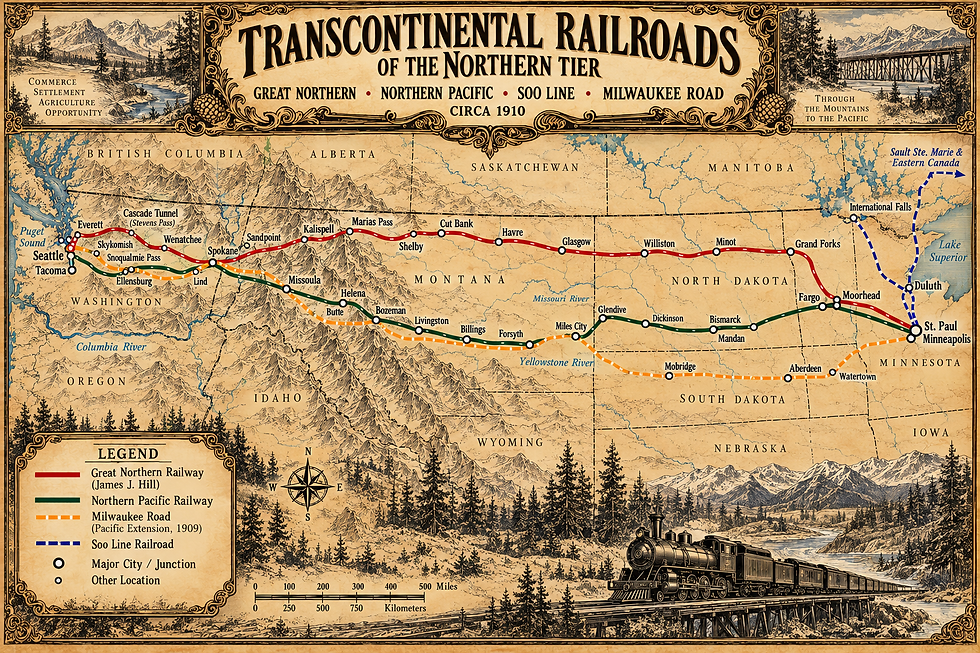
Today, I live along that same northern rail corridor. The railroad that once shaped the world of my great-grandparents now runs through mine. The locomotives have changed, the towns have changed, and the homesteaders, railroad workers, and families who watched those tracks spread across the prairie are long gone, but the rails are still here. Sometimes, while researching The Sunstone Path, I find myself following a piece of my family's history only to discover that it has somehow led me right back home.
-TJ Nilsdatter
Want more of the history behind the stories? Join The Anchor, my monthly newsletter, for behind-the-scenes looks at The Sunstone Path and The Unbreakable Anchor, historical discoveries, family stories, book news, and subscriber extras delivered straight to your inbox.


Comments